Protonmotive force - from motive protons to membrane potential
DOI:
https://doi.org/10.26124/bec.2025-0007Keywords:
charge, coupling, energy, force, oxidative phosphorylation, proton, redox pumpAbstract
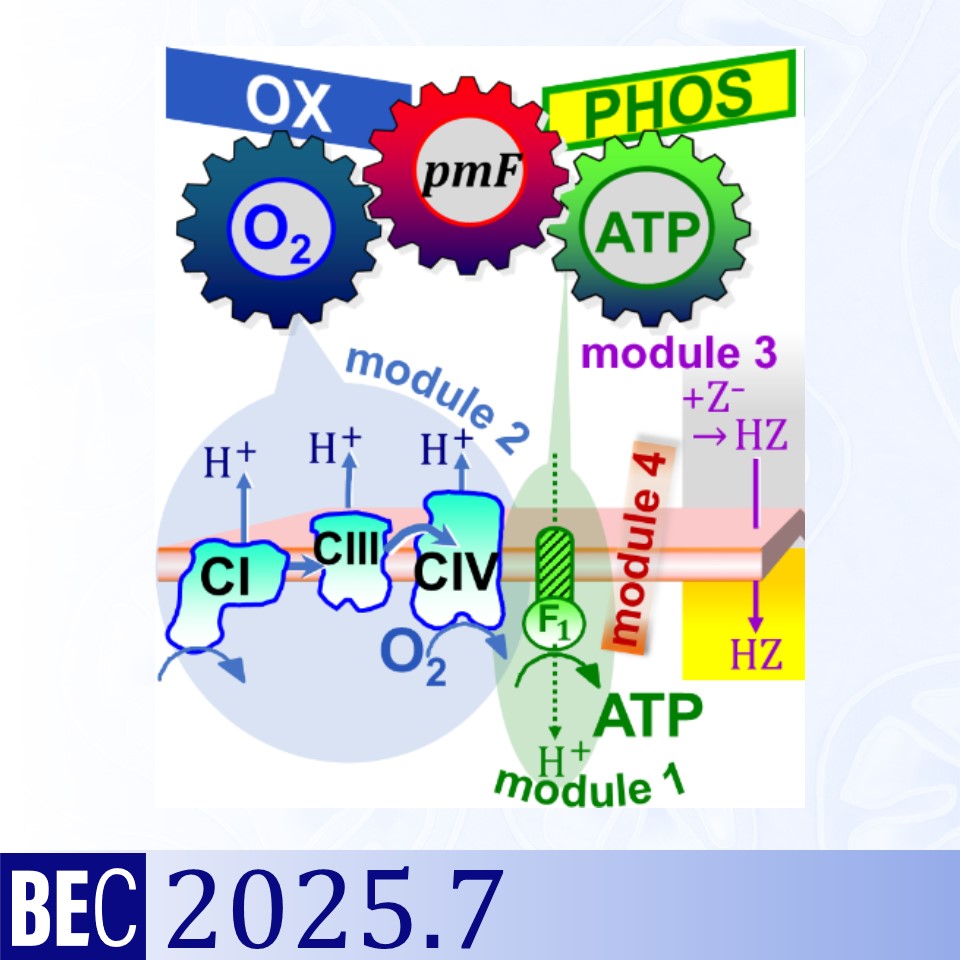
The protonmotive force (pmF) is central to oxidative phosphorylation (OXPHOS), coupling oxygen consumption (OX) in cell respiration to phosphorylation of ADP to ATP (PHOS). Defined as an electrochemical potential difference, the pmF consists of two components: the electric part pmFel, linked to the transmembrane potential difference (ΔΨ), and the diffusive part pmFd, related to the pH difference (ΔpH) across the mitochondrial inner membrane. Although pmFel is dominant in animal mitochondria, pmFd — often overlooked — contributes significantly under physiological conditions.
Peter Mitchell’s chemiosmotic theory defines four integrated coupling modules. Module 1: The ATP synthase utilizes the pmF producing ATP (PHOS). Module 2: The electron transfer system generates the pmF by redox-driven proton transport (OX). Module 3: Coupling of proton translocation to electroneutral ion exchange modulates the balance from pmFd to pmFel. Module 4: The coupling membrane integrates these structural and functional coupling modules.
A ΔpH of only 0.5 units contributes approximately 15–20 % to the total pmF, emphasizing that pmFd can provide a significant thermodynamic push. Oversimplified textbook conventions are challenged by rigorously incorporating stoichiometric numbers νH+ and the charge number zH+ in the equations defining the advancement of proton translocation and the protonmotive force. A transparent theoretical framework bridges theory and experiment with an innovative conceptual drive.
- The pmF explains the mechanism of OXPHOS coupling.
- H+-linked electron transfer in redox reactions drives compartmental H+ transport.
- The pmF with units [J·mol-1] or [V = J·C1] is isomorphic to physical forces with unit newton [N = J·m-1].
- Force times advancement of the motive quantity yields energy [J] in the form of exergy available for work.
Cite:
Gnaiger E (2025) The protonmotive force – from motive protons to membrane potential. Bioenerg Commun 2025.7. https://doi.org/10.26124/bec.2025-0007
References
Bureau International des Poids et Mesures (2019) The International System of Units (SI). 9th edition (V3.01 August 2024):117-216. ISBN 978-92-822-2272-0
Gnaiger E (2020) Mitochondrial pathways and respiratory control. An introduction to OXPHOS analysis. 5th ed. https://doi.org/10.26124/bec:2020-0002
Gnaiger E (2025) Mitochondrial respiratory function in living cells. https://doi.org/10.26124/bec.2025-0005
Gnaiger E (2025) Boltzmann and gas constant – ambiguities between energy and force. https://doi.org/10.26124/becprep.2025-0005
Kell DB (2024) A protet-based model that can account for energy coupling in oxidative and photosynthetic phosphorylation. https://doi.org/10.1016/j.bbabio.2024.149504
Komlódi T, Tretter L (2022) The protonmotive force – not merely membrane potential. https://doi.org/10.26124/bec:2022-0016
Mitchell P (1966) Chemiosmotic coupling in oxidative and photosynthetic phosphorylation. https://doi.org/10.1016/j.bbabio.2011.09.018
Downloads
Additional Files
Published
Issue
Section
Categories
License
Copyright (c) 2025 Erich Gnaiger

This work is licensed under a Creative Commons Attribution-NonCommercial-NoDerivatives 4.0 International License.